

Breathwork is a simple yet effective way to improve focus and manage stress. By intentionally controlling your breathing patterns, you can influence brain activity, regulate stress hormones, and enhance attention. Research-backed techniques like cyclic sighing, box breathing, and slow breathing can deliver noticeable results in just a few minutes a day.
Key Takeaways:
- Boost Focus: Techniques like slow breathing optimize oxygen delivery and balance brain chemicals like noradrenaline, improving attention.
- Reduce Stress: Activating the parasympathetic nervous system through breathwork lowers cortisol levels and increases heart rate variability (HRV).
- Quick and Accessible: Methods like cyclic sighing and box breathing can be practiced anywhere, requiring just 5–10 minutes daily for benefits.
Popular Techniques:
- Cyclic Sighing: Double inhale (nose) + long exhale (mouth) for quick stress relief.
- Box Breathing: Equal 4-second inhale, hold, exhale, and hold for calm under pressure.
- Slow Breathing: 5-second inhale and exhale (6 breaths/min) to improve long-term stress resilience.
Breathwork is a practical, science-backed tool to sharpen your mind and stay calm in daily life. Let’s explore the science and techniques behind it.
Breathing Technique: Focus
sbb-itb-364f168
The Science Behind Breathwork and Focus
To understand how breathwork sharpens focus, you need to explore how it influences three key biological systems: oxygen delivery, brain chemistry, and stress regulation. Together, these systems create the mental clarity that controlled breathing can unlock.
Oxygen Supply and Brain Performance
Controlled breathing improves oxygen delivery and balances carbon dioxide levels, which stabilizes blood pH and ensures steady blood flow to the brain. This supports optimal neuron activity and enhances cognitive performance.
Interestingly, your brain uses breathing rhythms as a kind of internal metronome to organize its electrical activity. Slow breathing – about six breaths per minute (0.1 Hz) – has been shown to modulate faster brain waves, especially gamma waves. These waves are crucial for communication between distant brain regions, enabling better attention control and adaptability to new information.
Nasal breathing provides an added benefit. Breathing through your nose helps synchronize activity in the cortical and limbic areas of the brain, which are tied to emotional regulation and focus.
But it’s not just about oxygen. Controlled breathing also impacts the brain’s chemical balance.
Noradrenaline and Attention Control
Noradrenaline is like a spotlight for your attention, helping you stay alert and focused. This chemical is produced in the locus coeruleus, a brain region that regulates arousal. Controlled breathing fine-tunes this system, enhancing mental clarity.
"Respiration may be an integral rhythm of the brain’s neural activity. This provides an intimate connection of respiration with neuro-mental features like emotion." – Neuroscience Bulletin
A study conducted in 2025 by researchers at the Universidad Iberoamericana Ciudad de México explored this connection. They worked with 15 healthy adults (average age 24) who practiced specific breathing techniques, like the 4-7-8 method (inhale for 4 seconds, hold for 7 seconds, exhale for 8 seconds) and a 5-8-5 pattern, for 10 minutes. EEG and HRV measurements revealed enhanced brain-heart communication, particularly in the gamma frequency band. This shows how conscious breathing can act as a "top-down" mechanism, allowing the brain to influence systems that usually operate automatically.
The gamma band is especially important because it serves as the primary communication channel between the brain and body during controlled breathing, giving you the ability to consciously influence processes like heart rate and stress response.
Speaking of stress, this is another area where breathwork plays a pivotal role.
Stress Reduction and Cortisol Control
Stress and focus are tightly linked. High cortisol levels can impair the prefrontal cortex, the part of the brain responsible for decision-making and sustained attention. Breathwork helps counteract this by activating the parasympathetic nervous system – your body’s "rest-and-digest" mode.
Slow breathing (around six breaths per minute) has been shown to boost heart rate variability (HRV) and lower cortisol levels. A healthy HRV, typically between 50 and 100 milliseconds, reflects a flexible and resilient autonomic nervous system. Breathing at this "resonance frequency" aligns your respiratory and cardiovascular systems, creating the ideal conditions for better focus.
In a 2025 study at the University of Innsbruck, 80 university students underwent a stressful cognitive test called the Paced Auditory Serial Addition Task (PASAT-C). Afterward, those who practiced 5 minutes of resonant breathing showed increased RMSSD (a key HRV measure) and felt less strain compared to those who simply rested.
"Slow breathing (SB) has been shown to be a simple yet effective stress-reducing technique… [it] acutely activates the parasympathetic nervous system, evidenced by increased heart rate variability (HRV), and decreases blood pressure and cortisol levels." – Scientific Reports
The benefits of stress reduction aren’t just short-term. Between May 2023 and the following months, the University of Nottingham Malaysia conducted a four-week study with 50 adults (ages 18–34). Participants in the mindfulness breathing group practiced 10 minutes of daily breathing exercises, including Kapalabhati and Nadishodhan Pranayama. By the end of the study, these individuals reported lower stress levels and improved cognitive flexibility compared to a control group that listened to music. Brain scans also revealed structural changes: increased grey matter density in the hippocampus (linked to memory and learning) and reduced density in the amygdala (associated with stress responses).
Research Studies on Breathwork for Focus
Scientific research has consistently shown that breathwork can enhance attention, cognitive performance, and stress management. Here’s a closer look at some key studies that highlight these benefits.
Trinity College Dublin Study on Noradrenaline (2018)

In 2018, researchers at the Trinity College Institute of Neuroscience, led by Michael Christopher Melnychuk, explored how breathing influences the Locus Coeruleus (LC) – the brain’s primary source of noradrenaline – using fMRI scans and pupil dilation measurements. Their findings revealed that the rhythm of breathing directly impacts noradrenaline levels, which play a crucial role in attention. Striking the right balance is key: too much noradrenaline can lead to anxiety and scattered thoughts, while too little may result in sluggishness. Breathwork techniques, such as pranayama, can help regulate this balance, optimizing focus and mental clarity.
"The locus coeruleus (LC) has established functions in both attention and respiration. Good attentional performance requires optimal levels of tonic LC activity, and must be matched to task consistently." – Michael Christopher Melnychuk et al., Trinity College Dublin
Cyclic Sighing and Cognitive Performance (Balban et al., 2023)
A 2023 randomized trial led by Balban and colleagues compared the effects of three breathwork techniques – cyclic sighing, box breathing, and cyclic hyperventilation – with mindfulness meditation, practiced daily for five minutes over a month. The results showed that cyclic sighing, which emphasizes longer exhalations, was the most effective in improving mood and reducing physiological arousal. This method lowers the respiratory rate and activates the parasympathetic nervous system, fostering a calm yet focused state. Participants practicing cyclic sighing reported better emotional regulation and reduced mental fatigue compared to those practicing mindfulness meditation.
Meta-Analysis on Slow Breathing and Executive Function
Adding to these findings, meta-analyses have confirmed that slow breathing – around 5 to 6 breaths per minute – offers significant benefits for executive function. Regular practice reduces stress levels and enhances heart rate variability, a key marker of stress resilience. These physiological changes not only improve stress management but also boost cognitive performance, particularly in high-pressure situations.
Breathwork Techniques to Improve Focus
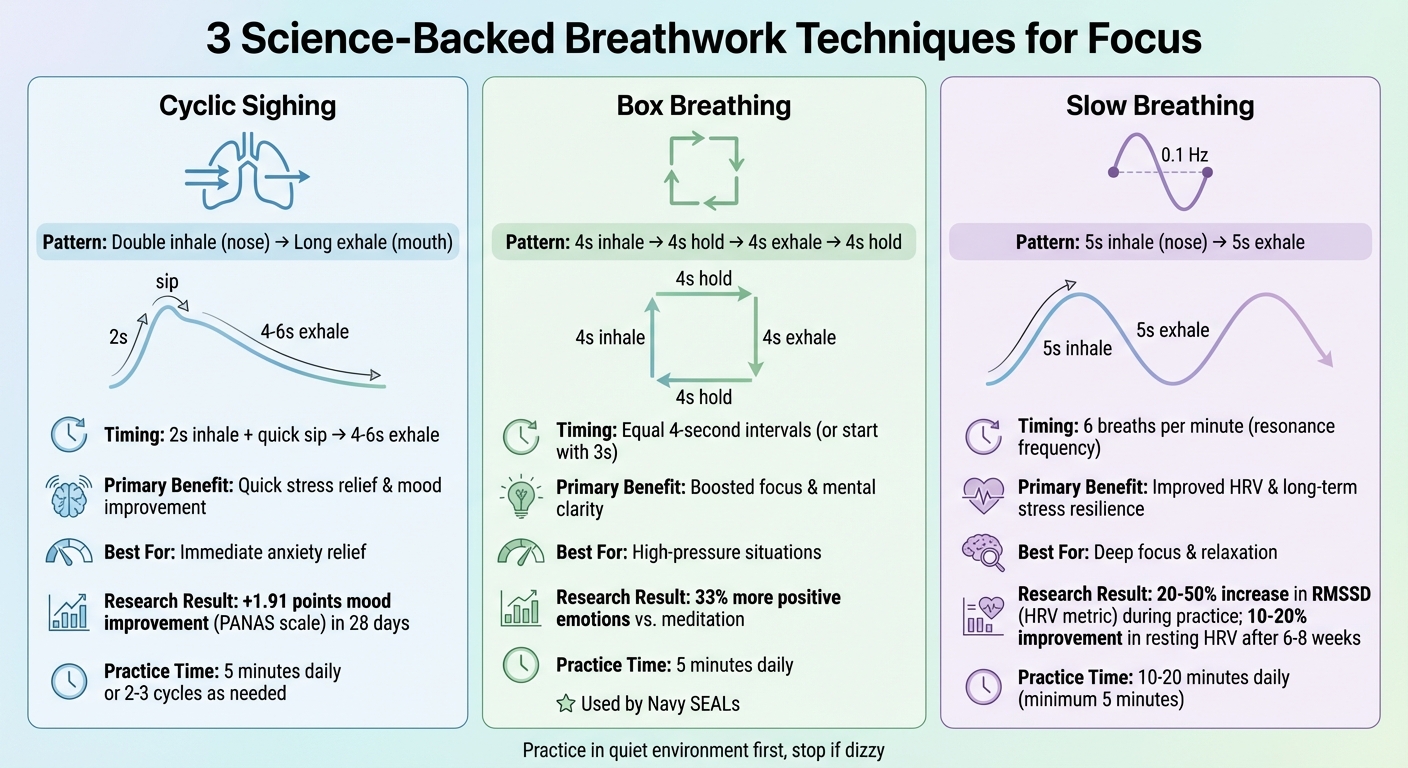
Breathwork Techniques Comparison: Cyclic Sighing, Box Breathing, and Slow Breathing
Here’s how you can use simple, science-backed breathing exercises to sharpen your focus in just a few minutes.
Cyclic Sighing
This method is perfect for reducing stress and lifting your mood quickly. Start by inhaling deeply through your nose for 2 seconds, then take a quick second sip of air to fully expand your lungs. Slowly exhale through your mouth for 4–6 seconds, which helps clear excess carbon dioxide.
A Stanford study from January 2023 revealed that practicing cyclic sighing for just 5 minutes daily over 28 days increased positive emotions by 1.91 points on the PANAS scale, outperforming mindfulness meditation (which scored 1.22 points). It also led to the largest drop in resting respiratory rate among 111 participants.
"What’s interesting about the breath is that it’s right on the edge of conscious control… you can very easily take over and control your breath, which then affects your overall physiology and stress response."
- David Spiegel, MD, Associate Chair of Psychiatry and Behavioral Sciences, Stanford Medicine
For quick relief, try 2–3 cycles whenever stress hits. To experience the full benefits, aim for 5 minutes of continuous practice. Many people feel calmer within just 30 seconds. Remember not to overfill your lungs on the first inhale – leave a little room for that second "top-off" breath.
Once you’ve tried cyclic sighing, move on to box breathing for an even deeper sense of calm and focus.
Box Breathing
Also called square breathing, this technique involves equal timing for each phase of the breath. Inhale through your nose for 4 seconds, hold your breath for 4 seconds, exhale through your mouth for 4 seconds, and hold again for 4 seconds before repeating.
Navy SEALs have relied on this method to stay calm and focused under pressure. It works by stabilizing the nervous system and ensuring a steady flow of oxygen to the brain. A 2023 study found that controlled breathing exercises like box breathing improved positive emotions by about 33% more than mindfulness meditation.
If you’re new to this, start with a 3-3-3-3 count until it feels natural, then gradually increase to the standard 4-second rhythm. Practice in a quiet spot at first, and later use it during stressful moments.
"Repeat this 4-4-4-4 breathing cycle."
- Raj Dasgupta, Pulmonary and Sleep Medicine Physician
If you start to feel lightheaded, stop and return to normal breathing. Even practicing for just 5 minutes a day can lead to noticeable changes over time.
For long-term balance and enhanced focus, try slow, rhythmic breathing.
Slow Breathing (6 Breaths Per Minute)
This technique is designed to improve heart rate variability (HRV), which is tied to better stress management and mental clarity. Breathe in through your nose for 5 seconds, then exhale for 5 seconds, keeping a steady rhythm of 6 breaths per minute. This pace matches your body’s natural resonance frequency, helping your heart and breathing work in sync.
Studies show that resonance breathing can increase a key HRV metric (RMSSD) by 20% to 50% during practice. With consistent daily sessions over 6–8 weeks, you could see a 10% to 20% improvement in your resting HRV. Sit upright to avoid compressing your diaphragm, which could limit the benefits. While 10–20 minutes per session is ideal, even 5 minutes can improve your mood and focus. Most people find their sweet spot between 4.5 and 7 breaths per minute, so adjust as needed. Tools like breathing pacer apps or biofeedback devices (e.g., HeartMath) can help you stay consistent.
| Technique | Pattern | Primary Benefit | Best For |
|---|---|---|---|
| Cyclic Sighing | Double inhale (nose), long exhale (mouth) | Quick stress relief and mood improvement | Immediate anxiety relief |
| Box Breathing | 4s in, 4s hold, 4s out, 4s hold | Boosted focus and mental clarity | High-pressure situations |
| Slow Breathing | 5s in, 5s out (6 breaths/min) | Improved HRV and long-term stress resilience | Deep focus and relaxation |
Key Takeaways and How to Apply Breathwork
Summary of Focus Benefits
Research highlights breathwork’s ability to lower stress (g = -0.35), anxiety (g = -0.32), and depressive symptoms (g = -0.40). Engaging in slow-paced breathing – approximately 6 breaths per minute – can improve prefrontal control and help you handle stress better. Studies also show that four weeks of mindfulness breathing meditation can significantly boost cognitive flexibility compared to control groups. This is largely because breath control influences vagal signaling, which plays a key role in regulating the nervous system. These insights form the foundation for the techniques and suggestions below.
Tips for Daily Practice
To make the most of breathwork, try incorporating these practical steps into your routine:
- Dedicate 5–10 minutes, twice a day, to breathwork exercises to build resilience. Regularity is more important than duration – while a single session might not yield immediate results, four weeks of consistent practice can lead to noticeable cognitive improvements.
- Start practicing in a calm environment to become comfortable with the techniques before using them in more stressful situations, like at work or school.
- For diaphragmatic breathing, lie on your back with your knees bent, placing your hands on your abdomen to feel the movement of your breath.
- Train yourself to breathe through your nose while falling asleep. This can help reduce snoring and improve overall sleep quality.
"Breathwork is one of the simplest and profoundly effective tools we have for calming the nervous system and boosting physical and mental resilience."
- Guy Fincham, Founder of the Breathwork Lab at Brighton & Sussex Medical School
Research Limitations and Future Directions
While the results are encouraging, there are notable gaps in the research. Many studies show a moderate risk of bias and often lack well-structured control groups. For instance, in a trial involving 400 participants, coherent breathing at 5.5 breaths per minute was no more effective than a placebo rate of 12 breaths per minute for improving mental outcomes. Maintaining long-term commitment to breathwork also poses challenges, as many participants struggle with adherence over time. Additionally, about 50% of participants in some mindfulness studies reported adverse experiences, such as anxiety or trouble sleeping. If you experience dizziness or discomfort during breathwork, stop immediately and return to normal breathing.
FAQs
Which breathwork technique is best for focus vs stress?
If you’re looking to sharpen your focus, slow and rhythmic breathing at a pace of about six breaths per minute can do wonders for mental clarity and cognitive function. Techniques like coherent breathing are particularly effective, as they not only enhance concentration but also contribute to overall well-being.
When it comes to managing stress, methods like box breathing – where you inhale, hold, and exhale for four counts each – can help calm the nervous system. Another option is diaphragmatic breathing, which promotes relaxation by stimulating the vagus nerve, a key player in reducing stress and encouraging a sense of calm.
How soon will I notice results from breathwork?
Consistent breathwork has been shown in scientific studies to potentially boost focus and mental clarity after just a few sessions. This practice may also help reduce cortisol levels and support better brain function, though results can differ from person to person.
Is breathwork safe if I feel dizzy or anxious?
Breathwork is typically safe for most people, but it’s important to pay attention to how your body responds. If you start feeling dizzy or anxious, take a break and return to your normal breathing pattern. Research shows that slow, steady breathing can help ease anxiety and manage negative reactions. Trust your body, and if any symptoms come up, take it slow and proceed carefully.