
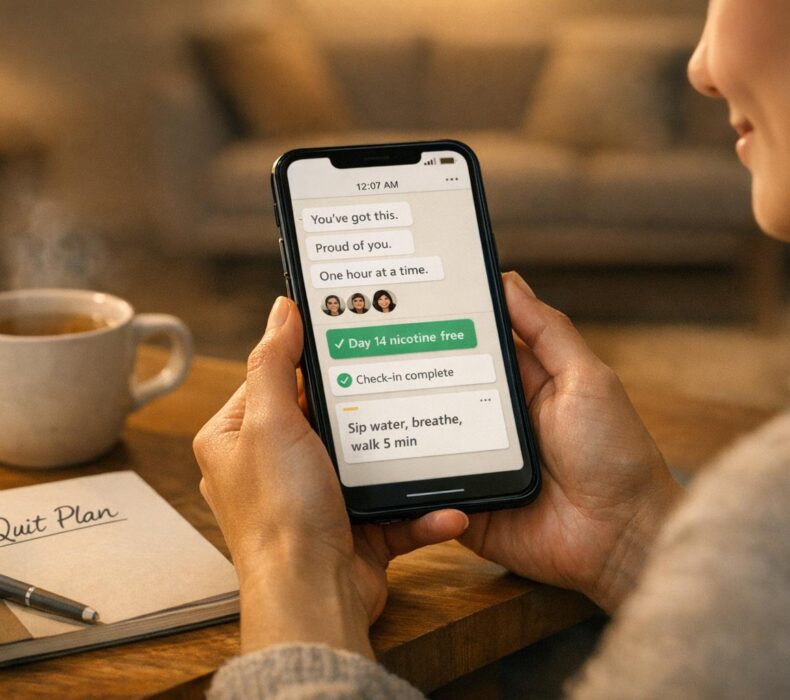
Quitting nicotine is tough, but online communities are making it easier. Platforms like Reddit, Discord, and TikTok provide support, advice, and a judgment-free space for people trying to quit. Here’s why they work:
- 24/7 Support: Real-time chats and posts help during cravings, even late at night.
- Accountability: Sharing progress and setbacks keeps you motivated.
- Practical Tips: Learn strategies from others who’ve quit successfully.
- Anonymity: Ask questions and share struggles without fear of judgment.
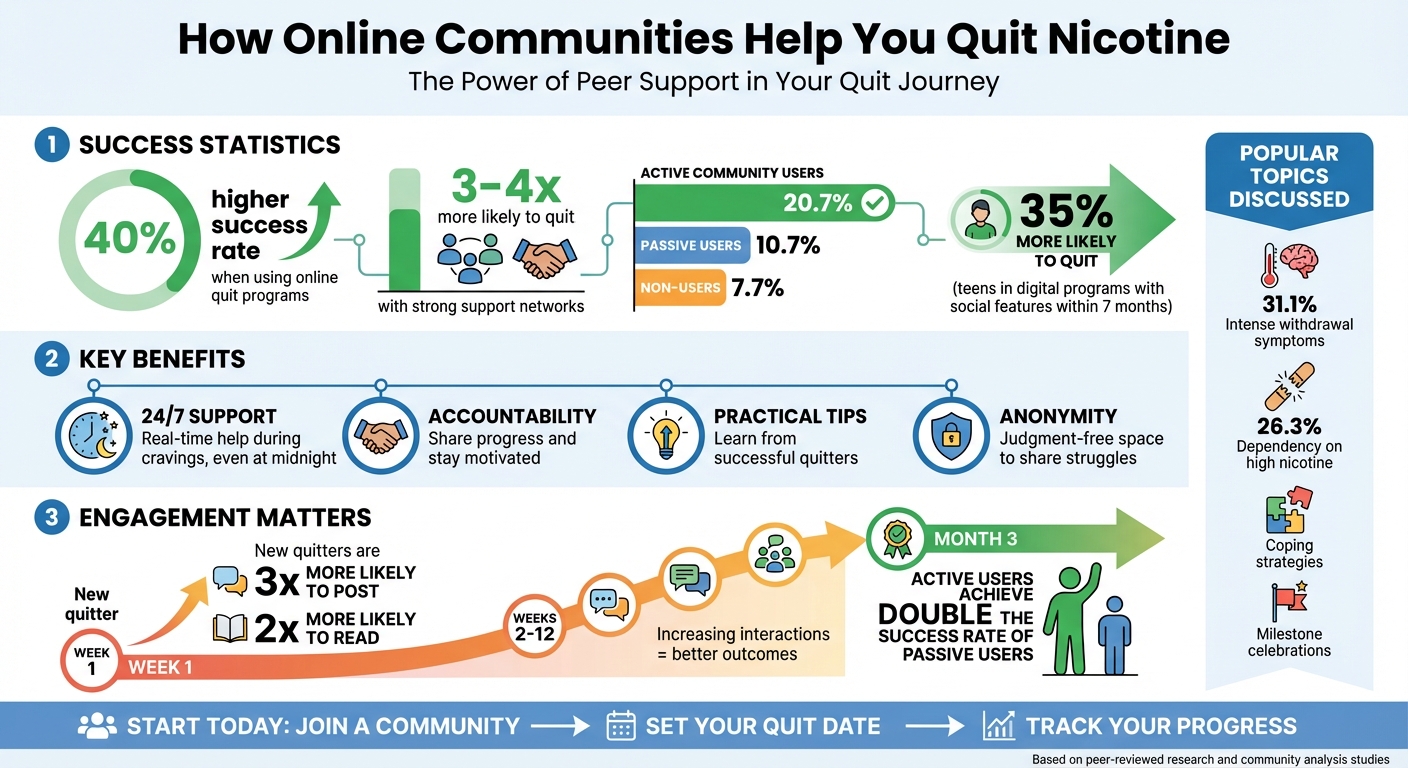
- Proven Results: People using online quit programs are up to 40% more likely to quit.
Joining the right platform, engaging early, and tracking progress can make all the difference. Pairing these communities with tools like best nicotine-free vapes helps tackle both the physical and emotional challenges of quitting. Start today by finding a group that fits your needs and take the first step toward a nicotine-free life.
How Online Communities Boost Nicotine Quitting Success Rates
Why Online Communities Work for Quitting Nicotine
Online communities provide a powerful boost for quitting nicotine by offering accountability, shared knowledge, and a safe space to connect.
Accountability and Peer Support
Connecting with others who are quitting creates a sense of accountability. When you share your progress or setbacks, you’re not just committing to yourself – you’re committing to the group. Studies show that having a strong support network makes you 3 to 4 times more likely to quit nicotine for good.
What makes online communities so effective is their constant availability. If a craving strikes at midnight, you can jump into a live chat or browse recent posts from people dealing with the same challenges. Real-time support through instant messaging can be the push you need to resist temptation. Plus, celebrating milestones together – whether it’s your first day nicotine-free or hitting one month – helps solidify your new identity as a non-user by exploring the benefits of nicotine-free vaping.
Learning from Others’ Experiences
These communities are also a goldmine of practical advice. Instead of generic suggestions, you’ll find real strategies that have worked for people in the same situation. Many users find success by switching to top vitamin vape brands as a transitional tool. In fact, recent quitters – those in their first week – are nearly three times more likely to post and twice as likely to read forum content. This creates a constantly updated pool of tips and insights.
Even if you’re not ready to actively participate, just reading others’ stories can be a game-changer. Dr. Amanda Graham, Director of Research Development at the Schroeder Institute, explains:
"By understanding how members use the site, we can identify the factors associated with positive outcomes, which could be harnessed to improve cessation rates".
The anonymity of online platforms also adds another layer of comfort, making it easier to absorb and apply these shared experiences without fear of judgment.
Anonymous and Judgment-Free Environments
Anonymity removes the fear of being judged. You don’t have to worry about letting down loved ones or facing criticism from colleagues. A 2021 analysis of the r/QuitVaping subreddit (with 4,700 members at the time) found that users openly discussed tough topics like "intense withdrawal symptoms" (31.1% of posts) and "dependency on high nicotine" (26.3% of posts).
These judgment-free zones encourage honesty. Whether you’re venting about irritability, admitting to a slip-up, or asking questions you’d hesitate to ask elsewhere, the community responds with empathy, not criticism. This emotional safety net makes a big difference – people who actively participate in online forums report greater confidence in their ability to quit compared to those going it alone.
sbb-itb-364f168
Getting Started with Online Quitting Communities
Learn how to join and make the most of supportive online spaces.
Finding the Right Platform
Start by choosing a platform that suits your preferences. If you enjoy detailed advice and longer personal stories, forums like Reddit’s r/stopsmoking or the BecomeAnEX message boards are great options. These platforms let you take your time exploring specific topics. For quicker, real-time interactions, platforms like Discord or app-based communities can provide immediate support and answers.
Your choice might also depend on your age and comfort level. For example, younger users (ages 13-24) often gravitate toward platforms like Discord or TikTok, where the hashtag #quitvaping has amassed over 806 million views. On the other hand, traditional forums tend to attract a wider age range. Many of these platforms are free, such as the EX Program (a collaboration between Truth Initiative and Mayo Clinic) or Smokefree.gov, a service provided by the U.S. government. If you prefer mobile tools, the QuitNic app combines community features with progress tracking and is available via app stores.
Before jumping in, spend a few days observing the discussions. Research shows that even "lurking" – reading posts without actively participating – can boost your chances of quitting. It provides reassurance that you’re not alone and offers practical coping strategies. Take your time to understand the tone of the community and identify members whose experiences resonate with you. Once you feel comfortable, you can begin engaging more actively.
Participating in Discussions
Once you feel ready, start joining the conversation. Introduce yourself within your first week. New quitters who post within seven days are nearly three times more likely to stay engaged compared to those who wait longer, and this early participation often leads to better outcomes. Your first post doesn’t need to be elaborate – just share where you are in your journey and the kind of support you’re seeking.
A May 2025 study in Internet Interventions analyzed a Discord quitting community for users aged 13-24. It found that 61.7% of participants actively contributed through messages or reactions, and this engagement significantly boosted their confidence in staying nicotine-free. Even small actions, like reacting to others’ posts or giving a “like,” count as meaningful participation if you’re not ready for longer contributions.
As you grow more comfortable, shift from seeking help to offering it. Supporting others not only builds your confidence but also strengthens your resolve to quit. Share tips that have worked for you, celebrate milestones with others, and offer encouragement when someone faces a setback. Use search tools or hashtags like #quittingnicotine to find discussions that address your specific challenges or withdrawal symptoms. Dr. J. Taylor Hays from Mayo Clinic emphasizes:
"Stopping smoking doesn’t need to be an individual activity. By being open and sharing with others you can strengthen your own road to recovery, and who knows, you might just help someone else along the way".
Setting Goals and Tracking Your Progress
Many quitting communities provide tools to help you monitor your progress. Look for features like milestone badges, nicotine-free day counters, or financial savings trackers. These tools help reinforce your identity as a non-user and give you tangible achievements to share with the group.
Set a quit date within the next two weeks to keep your momentum going. Spend the week before your quit date tracking your nicotine use to identify triggers and set realistic goals. This information can also help you ask for specific advice from the community.
Announce your milestones – like Day 1, Week 1, or Month 1 – in your group to receive encouragement and positive feedback. Studies show that using digital platforms like BecomeAnEX can increase a smoker’s chances of quitting by four times, thanks to the combination of tracking tools and social support. For young adults aged 18-24, text-based community support programs have been shown to improve quitting success rates by nearly 40% compared to those without similar support.
Nicotine-Free Vaping as a Transition Method
Nicotine-free vapes can be a helpful tool during the final stages of quitting. They address the physical habits tied to vaping – like the hand-to-mouth motion, visible vapor, and sensory triggers – without the addictive chemical. However, they are most effective when used in the last phase of quitting, as early use does not seem to have a measurable impact.
Quitting can be broken down into four phases: start with nicotine vapes, gradually reduce nicotine strength, switch to 0 mg nicotine-free vapes for 2–6 weeks, and finally stop vaping altogether. Blake Brown, a News Author, explains:
"Quitting nicotine isn’t a single act – it’s a sequence of substitutions that narrow until there’s nothing left to substitute."
This step-by-step approach allows individuals to maintain familiar routines while progressively reducing their dependence.
Types of Nicotine-Free Alternatives
Nicotine-free products are designed to mimic the sensory experience of smoking without delivering nicotine. Options include zero-nicotine disposables like the Geek Bar Pulse 15K ZERO ($19.99) and vitamin vapes that contain ingredients such as Vitamin B12 and organic fruit extracts. These products produce realistic vapor, satisfying the visual and sensory cues often associated with vaping. Brands like MELO Labs, Cyclone Pods, and ARRØ specifically cater to the nicotine-free market, offering clean formulas that avoid substances like Propylene Glycol, Diacetyl, and Vitamin E Acetate.
It’s important to buy from trustworthy vendors that provide lab results. A 2025 analysis revealed that some products labeled "0 mg" still contained detectable levels of nicotine. Look for batch authentication codes and third-party testing to confirm that your product is entirely nicotine-free. Websites like No Nic Vapes offer reviews and educational resources to help you find reliable options.
Discussing Nicotine-Free Products in Forums
Online communities can be a valuable resource for learning about nicotine-free alternatives. Members often share honest feedback about which brands deliver satisfying vapor and which fall short. They also warn about mislabeled products and discuss ingredients like Bacopa extract and vegetable glycerin, highlighting that "nicotine-free" doesn’t always mean "chemical-free".
Barb, a member of the EX Community, shared her experience:
"I finally learned how to quit and how important support from other quitters can be… Having a quit plan by identifying tools to use, how to cope with cravings and creating new associations to replace smoking/vaping."
Engaging with these communities can help you identify your specific triggers – whether they’re social, stress-related, or tied to certain routines like driving or after meals. Sharing your progress during the 2–6 week transition can also create a sense of accountability, ensuring that nicotine-free vapes remain a temporary aid rather than a new habit. By participating in these discussions, you can gain practical advice and encouragement tailored to your quit journey.
Tracking Your Success in Online Communities
When it comes to online quitting communities, tracking your engagement can make a huge difference. These metrics do more than just measure activity – they reinforce the benefits of peer support and accountability, which are essential for staying on track.
Metrics to Monitor
Your progress isn’t just about counting nicotine-free days. Social connectivity plays a massive role in your success. Here are some key metrics to keep an eye on:
- In-degree (incoming interactions): This tracks how many different members’ posts you read each week. Increasing this number – especially between weeks 2 and 12 – exposes you to a variety of quit strategies and inspiring success stories.
- Out-degree-aware (reciprocal outreach): This measures your interactions with others. Specifically, it means revisiting your posts to see who commented and acknowledging their support. It’s about building two-way connections.
- Platform usage: Pay attention to how often you return to the platform, how much time you spend there, and how many days you check in. Visiting frequently during your first week is particularly important for building momentum.
- Post types: In the early stages, your posts might focus on updates and seeking advice. By months two and three, you’ll likely notice a shift toward sharing success stories and quit strategies.
Dr. Amanda Graham, Director of Research Development at the Schroeder Institute, highlights the importance of these metrics:
"By understanding how members use the site, we can identify the factors associated with positive outcomes, which could be harnessed to improve cessation rates."
Tracking these numbers gives you a clearer picture of how your engagement influences your quit journey.
How Engagement Affects Quit Rates
Active participation makes a big difference. Active users – those who both read and contribute content – achieve a 20.7% abstinence rate at three months. That’s almost double the rate of passive users (10.7%), who only read, and nearly triple the rate of non-users (7.7%). Simply put, being active pays off.
Consistently measuring your interactions has a direct link to better outcomes. For example, teens in digital quit programs with social features were 35% more likely to quit vaping nicotine within seven months compared to those who didn’t participate. The magic lies in mutual interactions – the give-and-take of reading posts, receiving responses, and acknowledging others’ input. This "out-degree-aware" behavior is the strongest predictor of success for active users. Sarah Cha, Senior Project Manager at the Schroeder Institute, underscores this:
"Smokers who became more socially connected on BecomeAnEX were significantly less likely to be smoking three months after they enrolled."
The first month is especially crucial. New quitters are almost three times more likely to write a post and twice as likely to read community blog posts compared to those further along in their journey. Engaging early sets the foundation for lasting support and success.
Conclusion
Quitting nicotine is no easy feat, but online communities offer around-the-clock support and accountability that can be a game-changer. Research shows that individuals with strong support systems are 3–4 times more likely to quit nicotine for good, highlighting just how crucial peer connections can be during this journey.
Pairing the emotional support found in online communities with nicotine-free alternatives creates a powerful strategy. While forums and groups help address the emotional and social challenges of quitting, nicotine-free vaping product reviews can ease the physical rituals, like the hand-to-mouth habit, that are often hard to let go of. This combination lets your body start healing immediately while maintaining a sense of routine to make the transition smoother.
Staying engaged is especially important during those early weeks when cravings hit hardest. Whether you’re exploring resources like No Nic Vapes for nicotine-free options or actively participating in quitting forums, the key is to dive in and stay involved. Read posts, share your story, celebrate your progress, and connect with others who understand what you’re going through. These small steps build momentum and strengthen your resolve to stay nicotine-free.
Take the first step today by joining an online community. Share your experiences, set a quit date, and celebrate every milestone along the way. The journey to a healthier, nicotine-free life is yours to own, but walking it alongside others who’ve been there can make all the difference.
FAQs
How do I find a quitting community that fits me?
To discover a quitting community that fits your needs, check out online forums and social media groups dedicated to nicotine cessation. These spaces provide a mix of shared stories, encouragement, and actionable tips. You can find groups tailored to specific audiences – like younger individuals – or focused on particular quitting milestones. Many of these communities are moderated to maintain a positive and supportive atmosphere and are easily accessible through websites, apps, or social media platforms.
What should I post when I’m new and nervous?
If you’re just starting out and feeling anxious about quitting nicotine, try introducing yourself and sharing your goals. A post as simple as, "Hi, I’m new to quitting and feeling a little nervous, but I’m determined to stick with it. Any advice or encouragement would really help", can spark support and helpful advice from others. Being open and honest not only fosters connections but also helps ease the sense of isolation often felt during this journey in online communities.
How can I make sure a “0 mg” vape is truly nicotine-free?
To ensure a "0 mg" vape is genuinely free of nicotine, the most reliable approach is chemical analysis or lab testing. While product labels claim zero nicotine, reports have shown that some of these vapes may still contain trace amounts. Testing provides the most accurate verification.
Related Blog Posts
- How to Quit Nicotine Using Herbal Vapes
- 7 Benefits of Nicotine-Free Vaping for Your Health
- Checklist: Choosing Your First Nicotine-Free Vape
- Top Brands Offering Vitamin Vapes
Related: Arrø Review
Related: Nicotine-Free Vapes Vs Nicotine Pouches
Related: Complete Guide To Quitting Vaping