

Vitamin vapes and oral supplements both aim to deliver nutrients, but they differ significantly in how they work, their effectiveness, safety, and cost. Here’s a quick breakdown:
- Vitamin Vapes: Inhaled through the lungs, bypassing digestion for faster absorption. Popular for vitamins like B12, but they lack regulation, have safety concerns, and are relatively new with limited research.
- Oral Supplements: Consumed as pills, powders, or liquids. They go through the digestive system, offering reliable absorption backed by decades of research. Widely available and regulated.
Key Insights:
- Absorption: Vapes deliver nutrients faster but may risk overdosing; oral supplements offer steady absorption but can lose potency during digestion.
- Convenience: Vapes are portable and easy to use on the go. Supplements integrate well into daily routines but may require water or food.
- Safety: Vapes face concerns about inhalation risks and unregulated ingredients. Supplements are safer but can have contamination or interaction issues.
- Cost: Vapes are pricier over time; supplements are more affordable and accessible.
Bottom line: Oral supplements are safer, better-researched, and more reliable for long-term health. Vitamin vapes might suit specific needs, like avoiding needles, but should be used cautiously and under medical advice.
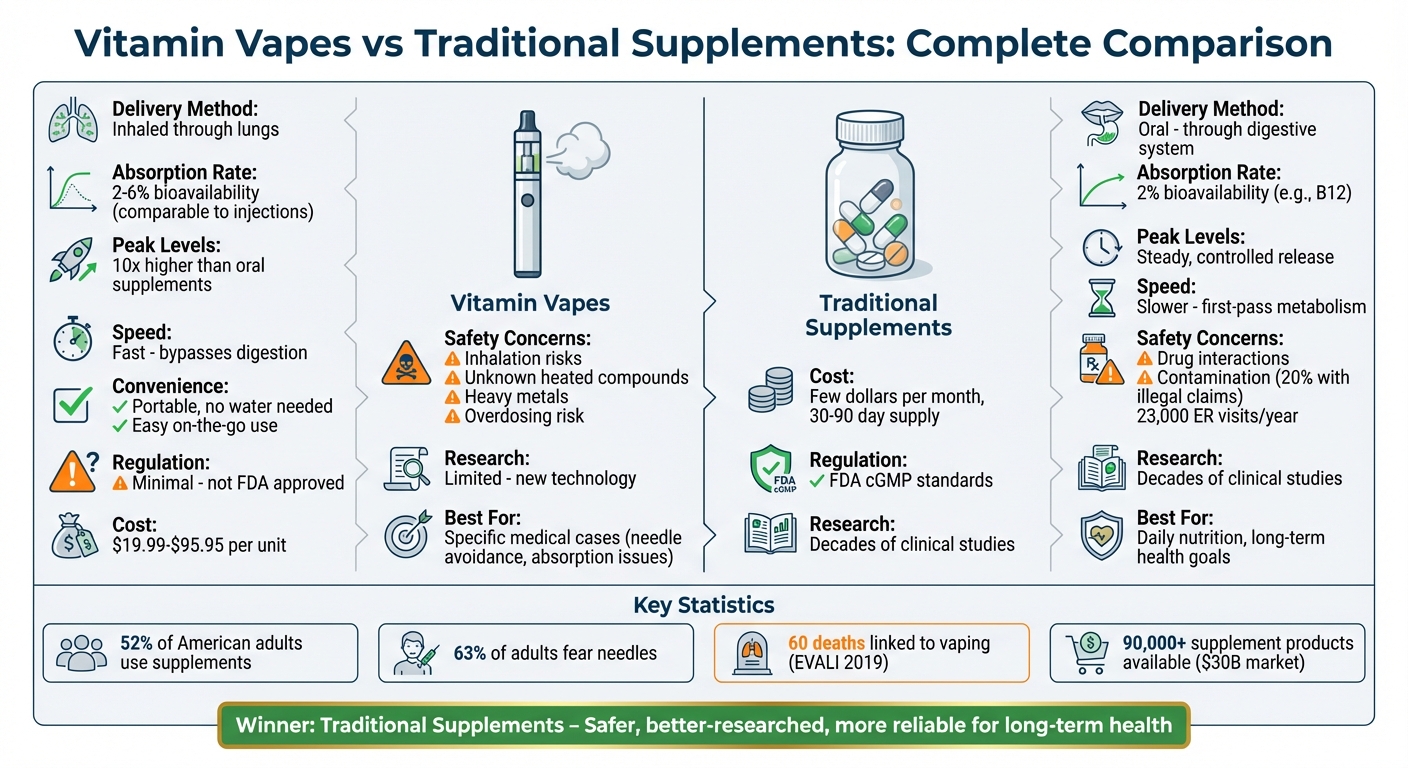
Vitamin Vapes vs Traditional Supplements Comparison Chart
Absorption and Effectiveness
How Vitamin Vapes Deliver Nutrients
When nutrients are inhaled, they are absorbed through the pulmonary alveoli in the lungs, allowing them to quickly enter the bloodstream. This process skips the digestive system and avoids the liver’s first-pass metabolism. As Professor Stephen R. Robinson explains:
Molecules absorbed from the lungs into the bloodstream travel directly to the heart, bypassing the liver, and are then distributed throughout the body.
The lungs provide a more accessible pathway for nutrient absorption compared to the digestive system. Their environment – characterized by a higher pH, reduced enzyme activity, and minimal mucus – favors better nutrient uptake. Additionally, smaller droplets can penetrate deeper into lung tissue, further enhancing absorption.
How Traditional Supplements Deliver Nutrients
Traditional supplements, on the other hand, depend on the digestive system for nutrient absorption. Once a pill or capsule is swallowed, the nutrients are released in the stomach and absorbed in the small intestine. From there, they enter the portal venous system, which transports them to the liver. This process exposes the nutrients to stomach acids, digestive enzymes, and the liver’s first-pass metabolism, which can significantly reduce the amount of active compounds available to the body. For instance, the oral bioavailability of vitamin B12 is only about 2%.
Comparing Absorption Rates
The differences between these two methods are striking. Inhalation leads to peak serum vitamin B12 levels that are roughly 10 times higher than those achieved through oral intake. Inhaled vitamin B12 has a bioavailability of 2%–6%, comparable to intramuscular injections and much better than oral forms. Moreover, inhalation provides a quicker spike in plasma nutrient levels compared to both oral ingestion and injections.
A study conducted in Ethiopia with preschool children demonstrated the effectiveness of inhaled nutrients. Administering 2 mg of aerosolized vitamin A every two weeks for three months resulted in a 2.1-fold increase in serum retinol levels and a 1.8-fold increase in retinol-binding protein. For nutrients like iodine, inhaled absorption can be nearly 100%.
However, rapid absorption comes with its own set of challenges. Professor Robinson notes:
The high effectiveness of the pulmonary route introduces concerns regarding overdosing and toxicity.
This highlights the importance of precise formulation and careful dosing to balance the benefits of fast absorption with safety considerations.
Convenience and Practicality
Using Vitamin Vapes
Vitamin vapes are compact, lightweight, and easy to carry, making them a great fit for purses or backpacks. Unlike traditional pills, they don’t need water or any preparation – just inhale when you’re ready for a quick wellness boost.
This portability makes them especially appealing to people with busy lifestyles, such as professionals and students. As one user, Melissa L., shared:
Fits in my purse and I can use it when I’m out with friends and they’re smoking or vaping… this is great as it doesn’t contain any nasties.
For those needing regular B12 supplementation but wanting to avoid needles, vitamin vapes offer a painless and simple alternative that doesn’t require a medical professional. At around $25, a B12 inhaler lasts one to two months, costing less than $1 per day.
That said, there are some drawbacks. Rechargeable devices require battery upkeep, while disposable vapes contribute to environmental waste. Plus, there’s limited clinical evidence to confirm that inhaled vitamins are absorbed as efficiently as oral supplements. These practical issues highlight some of the challenges vitamin vapes face compared to traditional options.
Using Traditional Supplements
Traditional supplements come in many forms – tablets, capsules, gummies, powders, liquids, and teas – allowing them to fit a variety of routines. Whether it’s swallowing a pill with breakfast or mixing a powder into a smoothie, these options can easily become part of daily habits.
However, they’re not always convenient for on-the-go use. Many require water or food for ingestion, and powders need to be mixed with a liquid, which isn’t ideal for immediate use. Additionally, swallowing difficulties are common; 72.9% of such reports involve multivitamins, and some people experience "pill fatigue" from taking multiple supplements daily.
Despite these inconveniences, traditional supplements have well-documented effectiveness. For example, multi-ingredient powders have been shown to significantly increase levels of folate, zinc, and vitamin C in healthy adults. With over half of American adults (52%) taking at least one dietary supplement, this method remains a trusted choice.
Which Is More Convenient?
The better option depends on your lifestyle and priorities. Vitamin vapes shine when it comes to portability and ease of use. As Vessel Brand puts it:
There is no question that vaping vitamins could be convenient. You can do it in the car on the way to work if you don’t have time for a healthy breakfast.
For those who fear needles – 63% of adults, according to research – vapes also provide a practical alternative to injections.
On the flip side, traditional supplements offer proven absorption, regulatory oversight, and cost-effectiveness for long-term health goals. They work best for home routines where daily habits can be established. For individuals who dislike swallowing pills, liquids or powders mixed into water offer a reliable, evidence-backed solution.
Ultimately, the choice comes down to balancing convenience with dependable nutrient delivery. While portability is essential for some, absorption rates and safety should also play a key role in deciding what works best for you.
Vitamins Can Be Inhaled, But Should They Be?
sbb-itb-364f168
Safety Considerations
Weighing the risks and benefits is crucial when deciding between vitamin vapes and traditional supplements. One significant concern with vitamin vapes is how the lungs handle substances compared to the digestive system. Ingredients that are safe to ingest might become harmful when inhaled. The CDC highlights this issue:
Some flavorings used in e-cigarettes may be safe to eat but not to inhale because the lungs process substances differently than the gut.
Heating vitamins on metal coils can also lead to the formation of unknown compounds. For example, inhaling Vitamin C – an acidic compound – could irritate lung tissue, and there are concerns that inhaling Vitamin D might even be toxic. Regan Bailey, a nutritional epidemiologist at Purdue University, underscores the uncertainty:
We know literally nothing about the safety or efficacy of inhaling vitamins.
Additionally, vitamin vape aerosols may contain particles, heavy metals like nickel and lead, and volatile organic compounds that can penetrate deep into the lungs. Long-term vaping has been associated with reduced blood vessel function, possibly due to airway irritation triggering signals in the vagus nerve, which can cause systemic vascular damage.
Practical risks also exist. Over 80% of calls to U.S. poison control centers about e-cigarettes involve children under 5 years old, and defective batteries in vaping devices have been known to cause fires or explosions during charging. However, traditional supplements come with their own set of safety concerns.
Safety of Traditional Supplements
While vitamin vapes raise concerns about inhalation, traditional supplements have their own risks. Each year, dietary supplements are linked to 23,000 emergency room visits in the U.S.. Key issues include drug interactions – for instance, St. John’s wort can reduce the effectiveness of prescription medications – along with potential liver damage and complications such as increased bleeding during surgery.
Another concern is product contamination. Some supplements have been found to contain unlisted prescription drugs, including anticoagulants or anticonvulsants. In one government study of 127 supplements marketed for weight loss or immune support, 20% made illegal health claims.
Given these risks, the FDA advises consulting a healthcare provider before starting any supplement, particularly if you are pregnant, nursing, or preparing for surgery. Following label instructions and stopping use if adverse effects occur are also important precautions.
Regulation and Product Quality
The safety challenges of both vitamin vapes and traditional supplements are further complicated by differing regulatory standards. Traditional supplements are not pre-approved by the FDA. Manufacturers are required to follow Current Good Manufacturing Practices (cGMPs) to ensure quality, but the FDA typically intervenes only after safety issues arise.
Vitamin vapes face even fewer regulatory checks. Since they are inhaled rather than ingested, they do not fall under the Dietary Supplement Health and Education Act of 1994. They also bypass tobacco regulations because they lack nicotine. As a result, vitamin vapes often reach the market without any established inhalation safety testing.
The FDA has warned vitamin vape companies about making unverified health claims for conditions like ADHD, asthma, and cancer. The dangers of vaping were highlighted in 2019, when 60 deaths were linked to EVALI (e-cigarette or vaping product use-associated lung injury). Vitamin E acetate – a food additive safe for ingestion – was identified as a major culprit when inhaled.
For traditional supplements, the FDA’s Dietary Supplement Ingredient Directory can help consumers check if specific ingredients have been flagged for safety concerns. On the other hand, vitamin vapes currently lack any established safety standards for inhaling nutrients.
Cost and Accessibility
Cost of Vitamin Vapes
Vitamin vapes generally start at $19.99 for a single disposable pen, with bundle options like $54.00 for three pens (discounted from $60.00) and $95.95 for a six-pack variety bundle (reduced from $119.94). While the upfront cost might seem manageable, the need for frequent replacements adds up over time.
For those seeking a more sustainable option, rechargeable pod systems can be a better choice. Replacement pods for these systems are priced between $16.49 and $21.99. Shannon F., a verified buyer, shared her experience:
I love this rechargeable vape and the flexibility to switch out the pods. It feels less wasteful than disposable options.
On average, adult e-cigarette users spend $82.22 monthly on vaping products. For individuals relying on vitamin vapes daily, this expense can become a notable part of their wellness budget.
Cost of Traditional Supplements
The U.S. supplement market offers over 90,000 products, collectively worth $30 billion. These range from affordable generic vitamins to high-end multi-ingredient blends. Multivitamins, for instance, can cost just a few dollars per month, with a single bottle often lasting 30 to 90 days. Given that 52% of American adults already use at least one dietary supplement, these products are designed for consistent and budget-friendly use.
Which Offers Better Value?
When comparing costs, traditional supplements generally provide better long-term value. Their lower price per serving and extended shelf life make them a more economical option for daily nutritional needs. For example, a month’s supply of vitamins typically costs far less than the average $82.22 spent monthly on vaping products.
That said, vitamin vapes might make sense in specific scenarios. Dr. Clare Morrison, GP & Medical Advisor at Medexpress, highlights that vitamin B12 vaping is:
less expensive than traditional needle shots and convenient.
For individuals needing B12 supplementation but wanting to avoid injections, vitamin vapes can be a practical and cost-effective alternative.
Accessibility is another factor. Traditional supplements are widely available at pharmacies, grocery stores, and major online platforms, making them easy to purchase. On the other hand, vitamin vapes are mostly sold through specialized brand websites and niche online retailers, which can limit their availability.
Conclusion: Which Works Better?
Key Takeaways
When comparing traditional supplements and vitamin vapes, the evidence strongly favors traditional supplements as the safer and more effective choice. These supplements provide nutrients in forms that are well-absorbed and backed by extensive clinical research. On the other hand, vitamin vapes come with safety concerns and lack substantial evidence to support their effectiveness. Past incidents involving unregulated inhalation methods highlight the potential risks.
While studies show that inhaled vitamin B12 can achieve bioavailability rates between 2% and 6% – similar to intramuscular injections – the wellness industry’s vitamin vapes remain largely unregulated. Traditional supplements, however, benefit from rigorous oversight and established safety standards. As Dr. Michael Ong from UCLA points out:
We know that some things that are safe when ingested are not necessarily safe when heated in a vape pen and then inhaled.
These facts point to a clear conclusion: for everyday nutritional needs, traditional supplements are the better choice.
Making the Right Choice for You
If you’re looking for safe, reliable, and affordable ways to maintain your nutrition, traditional supplements are the way to go. They are perfect for addressing deficiencies, supporting long-term health goals, and are widely trusted by millions of U.S. adults for these purposes.
Vitamin vapes, on the other hand, might only be considered in specific medical cases – such as for individuals with severe absorption issues or those who cannot tolerate needles. Even then, they should only be used under medical guidance. As Dr. Ron Crystal from Weill Cornell Medicine emphasizes:
The concept of just taking vitamin B12 to increase your energy and so on is a myth.
Before making any changes to your supplement routine, it’s always best to consult with your healthcare provider.
FAQs
Are vitamin vapes safe to use over time?
The long-term effects of using vitamin vapes are still uncertain, mainly because research in this area is limited. While they might seem like a quick and easy way to take vitamins, experts warn that inhaling nutrients could come with risks we don’t fully understand yet. Current studies don’t provide enough information to determine the safety of regular, prolonged use.
If you’re thinking about trying vitamin vapes, it’s a good idea to talk to a healthcare provider first. They can help you decide if this option fits your health goals and guide you toward safer, well-researched ways to meet your nutritional needs.
Are vitamin vapes more affordable than traditional supplements?
Vitamin vapes are often seen as a more affordable alternative to traditional supplements, thanks to their ease of use and simplified approach. Unlike pills or liquid supplements, they don’t require extra packaging or complicated dosing instructions, which can help keep costs down. Pricing varies depending on the brand, ingredients, and how often you use them, but many people consider them a budget-friendly choice.
On average, the monthly cost of vaping-related products, including vitamin vapes, tends to be moderate compared to some traditional supplement routines. That said, it’s always smart to take a closer look at your own usage patterns and compare expenses to make sure they fit your health goals and financial plan.
Are there any health risks associated with vitamin vaping?
Vitamin vaping presents potential health concerns, as the effects of inhaling vitamins in vapor form aren’t fully understood yet. Experts warn that heating liquids containing vitamins could lead to the formation of harmful byproducts or chemical residues from additives often found in vape formulations. Unlike traditional nutrient absorption through digestion, inhaling vitamins bypasses this natural process, which may lead to lung irritation or inflammation.
A particular concern involves substances like vitamin E acetate, which has been linked to cases of vaping-associated lung injury. Although not all vaping products include this ingredient, the long-term impact of inhaling vitamins remains unclear. Health professionals recommend exercising caution, as this practice could pose unexpected risks to respiratory health until further research provides more clarity.
Related Blog Posts
- How to Quit Nicotine Using Herbal Vapes
- Do Melatonin Vapes Actually Help You Sleep?
- Top 7 Nicotine-Free Vapes for Stress Relief
- Best Melatonin Vape Brands in 2026
Related: Melatonin Vapes Vs Gummies
Related: Do Vitamin Vapes Work